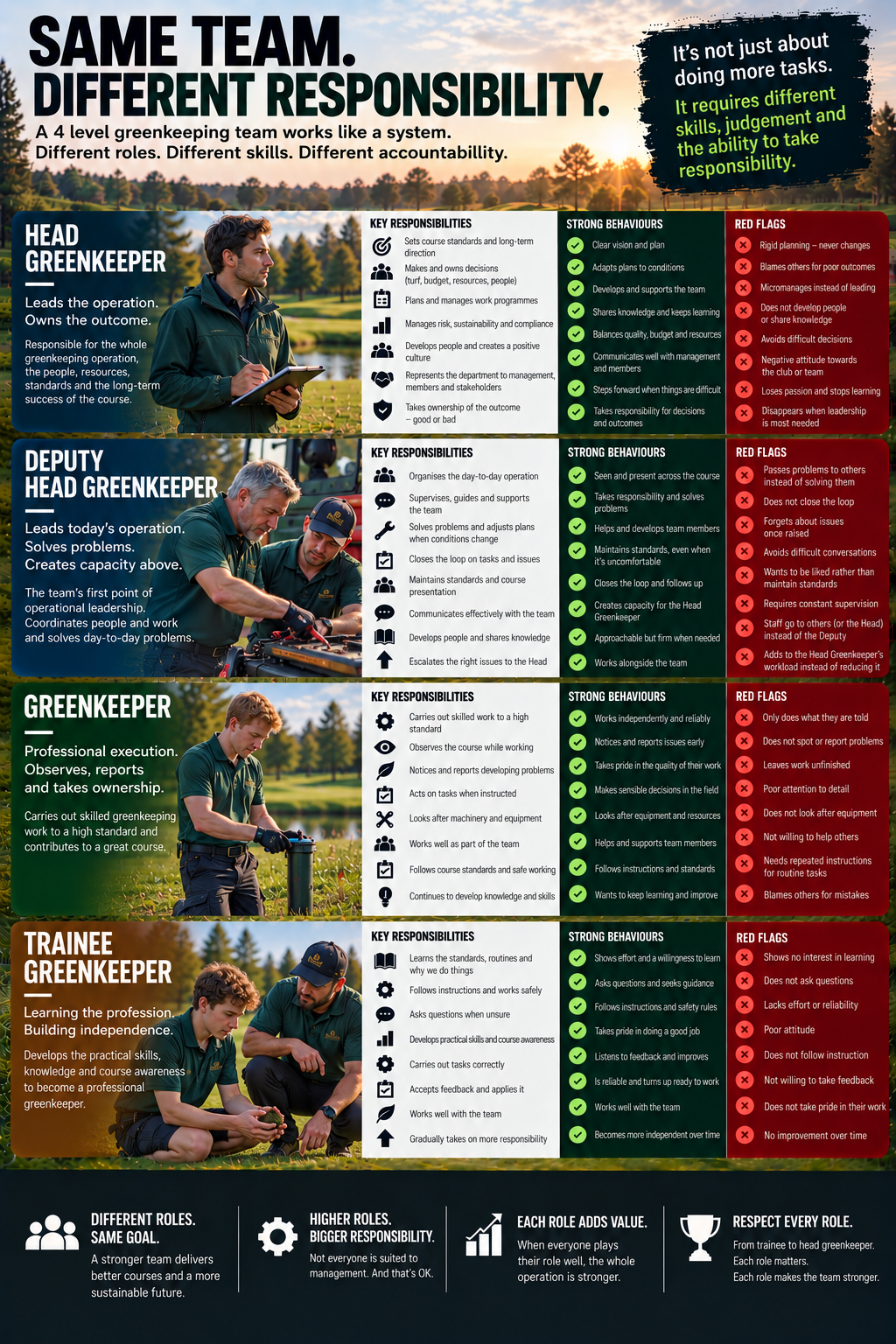
Same Team. Different Responsibility.
A greenkeeping team is not simply a group of people carrying out increasingly senior versions of the same job.
A Trainee Greenkeeper, Greenkeeper, Deputy Head Greenkeeper and Head Greenkeeper each have a different function. As someone moves through those roles, the change should not simply be more pay, more experience or a different job title.
The type of responsibility changes.
That distinction matters to greenkeepers. It matters just as much to the golf clubs employing them.
A good Greenkeeper does not automatically make a good manager
Greenkeeping is a professional job.
A competent Greenkeeper should be able to carry out skilled work independently, recognise the required standard and observe what is happening around them.
If they notice a damaged bunker edge, irrigation problem or developing turf issue, they should not simply drive past it because it was not on today's job list. They may not have the time or authority to fix it immediately, but they should recognise it and report it.
That is professional ownership.
But being very good at this does not automatically make someone a good Deputy.
And being an excellent Deputy does not automatically make someone capable of being a Head Greenkeeper.
Management requires additional skills.
The Deputy should create capacity
The Deputy Head Greenkeeper is one of the most important positions in a small greenkeeping team.
Their role is not simply to be an experienced Greenkeeper who takes charge when the Head is absent.
A strong Deputy becomes the team's first operational point of leadership.
When staff encounter problems they cannot resolve themselves, the Deputy should normally be the person who helps them move forward. They coordinate work, maintain standards, solve appropriate problems, share knowledge and deal with situations before everything has to reach the Head Greenkeeper.
Most importantly:
A good Deputy creates capacity for the Head Greenkeeper. They should not continually create additional work for them.
If every problem passes through the Deputy and lands on the Head's desk, the organisation may have a Deputy on its payroll without actually receiving the Deputy function.
Being approachable also matters, but leadership cannot be based entirely on being liked.
Sometimes supervision means saying:
This needs doing again.
This standard isn't acceptable.
We agreed something different.
Good leadership combines support with the ability to act when something is uncomfortable.
The Head owns the outcome
The Head Greenkeeper's responsibility changes again.
They set direction, make decisions, manage resources, develop people and create the environment in which the rest of the team operates.
And ultimately:
They own the outcome — good or bad.
That is one of the parts of senior management that can be underestimated.
Wanting the title is different from being prepared to carry the responsibility that comes with it.
A strong Head also cannot simply blame a weak Deputy indefinitely. Once a performance problem becomes clear, addressing it becomes part of the Head Greenkeeper's responsibility.
Likewise, a poor Head can restrict an excellent Deputy through micromanagement, weak communication, withholding authority or failing to develop them.
Accountability therefore works in both directions.
Employers should know what they are paying for
Years of service matter. Experience matters. Technical knowledge matters.
But they are not the same as management capability.
For golf clubs, the important question should not simply be:
“How long has this person worked in greenkeeping?”
It should also be:
“Are they actually performing the responsibilities of the position we employ them to hold?”
A healthy greenkeeping structure is not built around status.
It is built around clearly understood responsibility, professional behaviour and people who make the level around them stronger.